Customizing Your Pickleball Paddle: Overgrips and Weighted Tape
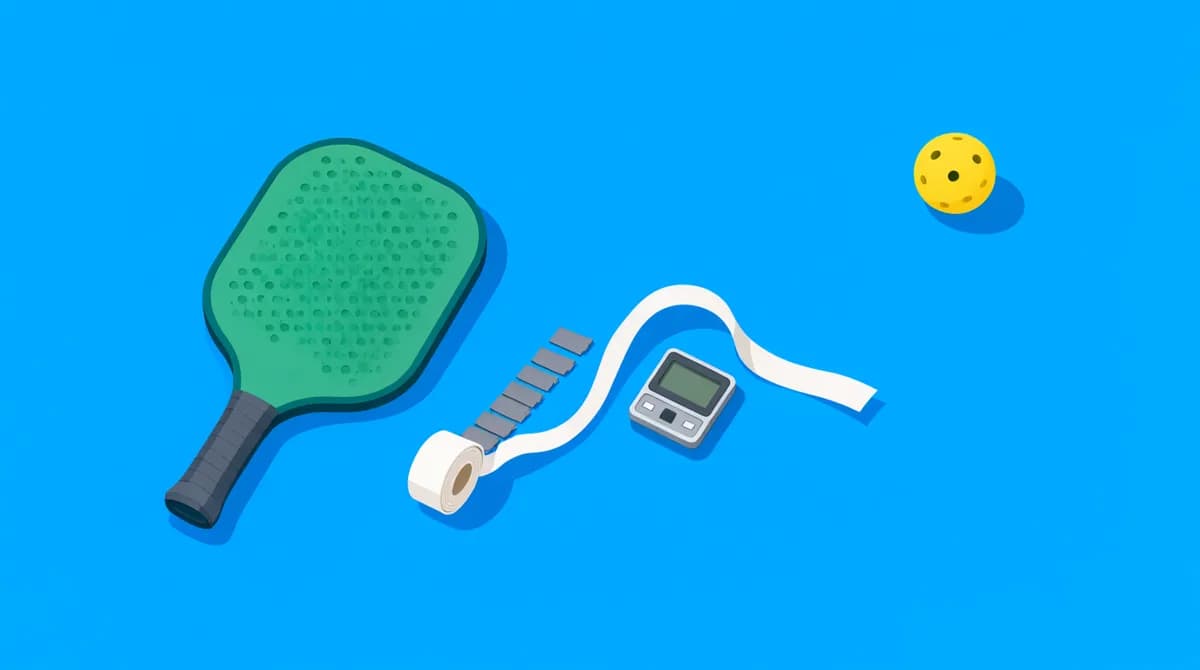
Two cheap upgrades change how a paddle feels more than most paddle swaps do: a fresh overgrip and a few grams of weighted tape. Both cost a few dollars, both take ten minutes, and both are reversible. Both are also easy to overdo. This guide covers what each one changes, where to put it, how much to use, and what the rules allow.
Start with the grip, because it sets your hold
There are two kinds of grip product, and they do different jobs.
- Replacement grip: an adhesive-backed foam or synthetic wrap, roughly 1.5 to 2.5 mm thick depending on brand. It is the base layer of the handle. Replace it when it goes slick, flat or starts peeling.
- Overgrip: a thin, stretchy tape, roughly 0.5 mm thick, that you wrap over the base grip. It is the layer you swap often, the way you would change a tennis overgrip.
Retailer sources put one overgrip layer at about 1/16 inch of extra circumference, and two layers at about 1/8 inch, which is a full grip size. Treat those as ballpark figures, since thickness varies by brand and how tightly you wrap.
How to wrap an overgrip
- Peel off the old overgrip and check the base grip underneath. If it is damaged, replace it instead of wrapping over it.
- Start at the butt cap end. Line the first edge up with the seam pattern of the stock grip so the handle does not feel lumpy.
- Spiral upward in the same direction as the existing wrap, overlapping each pass slightly. A thin overlap of about 1/8 inch is a common recommendation. One viewer comment on a recent West Side Pickleball video argued the creator overlapped too much, so a narrow overlap is the safer choice.
- Control tension. Pulling hard makes the handle feel thinner and firmer. Wrapping loosely gives a thicker, more cushioned, plusher feel. Neither is wrong, so pick the one that matches how you like to hold the paddle.
- At the top, trim the tail, then cut it on a diagonal so it finishes flat, and seal it with the finishing sticker or tape.
If you have tennis elbow or sore wrists, a slightly thicker, softer handle can help, but grip choice is only one factor. Our tennis elbow paddle guide covers the paddle side, and this is not medical advice. If it hurts, see a clinician.
Sweaty hands wear overgrips out fast. If yours turns slick in a few sessions, see our tips on cleaning your paddle grip, and replace the overgrip as soon as it stops feeling tacky.
What weighted tape actually changes
Adding weight does not just make a paddle heavier. Where the weight goes decides what you feel.
| Where you put it | What it mainly does | Trade-off |
|---|---|---|
| Head or tip (12 o'clock) | Raises swing weight, adds power on drives and overheads | Slower hands at the net, more arm effort |
| Sides (3 and 9 o'clock) | Raises twist weight, so off-center hits twist the face less | Slightly less maneuverable |
| Throat, just above the handle | Adds stability with little change to swing weight | Smaller effect on power |
| Handle or butt cap | Shifts balance toward your hand, so the head feels lighter | Less plow-through on drives |
Two terms matter here. Swing weight is how heavy the paddle feels as you swing it, and it depends mostly on how far the weight is from your hand. Twist weight is how much the paddle resists rotating when you hit off-center. For more definitions, see the pickleball glossary.
Sources vary on amounts, but the common advice is consistent: start small. Many guides suggest 2 to 3 grams per side for a first try at 3 and 9 o'clock, and some suggest 1 to 3 grams total. Add weight in increments of 1.5 to 3 grams, not in big jumps.
A real example: strips low on a hybrid
In a short video from the West Side Pickleball channel, the creator customized a Gearbox Pressure X flat-top hybrid. They used pre-cut weighted strips, some 5 grams and some 3 grams each, and said a hybrid paddle can afford the 5 gram pieces. Their placement goal was to keep swing weight low while adding stability, so they put the strips low near the neck, just above the corner of the face, rather than at the tip. They also skipped edge guard protectors because those add weight, and they wanted the paddle to stay fast at the net. They said the video was not sponsored.
That is one player's setup, not a rule. The useful idea is the reasoning: decide what you want (stability, not raw power), then place the weight where it gives that without slowing your hands.
Rules for adding weight
- Weigh the tape before you stick it. Length is a poor guide, because tape weight per inch varies by brand.
- Keep sides matched. If you put 2 grams at 3 o'clock, put 2 grams at 9 o'clock. Uneven weight makes the paddle feel wobbly.
- Change one thing at a time. Play a full session before adding more.
- Clean and dry the edge before applying, and press the tape down firmly so it does not peel mid-rally.
- Cover lead tape. Some clubs ask players to cover lead with a protective layer, and handling lead means washing your hands afterward. Tungsten tape is a non-lead alternative. Our roundup of the best lead tape for pickleball paddles lists options.
Is it legal for tournaments?
Secondary sources agree that grip changes and weighted tape on a commercially made paddle are generally allowed, as long as the tape stays off the hitting surface. Adding anything to the face to increase spin, such as grit, paint or resin, is not allowed, and neither is drilling into the paddle or reshaping the handle. Older rulebook text also set placement limits for tape, and the numbering differs between sources, so I could not confirm the current wording. Before a sanctioned event, read the current USA Pickleball rulebook, and ask the referee if you are unsure.
A simple starting plan
- Replace a worn grip, or wrap a fresh overgrip with light tension. Play two sessions.
- If the paddle twists on off-center hits, add 2 grams at each of 3 and 9 o'clock. Play a session.
- If drives feel weak and your hands are fast enough, try 2 to 3 grams at the tip. If your hands feel slow at the kitchen line, take it off.
- Keep notes. Weight and placement, plus how a session felt, is enough to find what works.
If the paddle still feels wrong after small tweaks, the paddle may simply not suit you. Try the paddle finder or browse our best paddles pages before you keep adding tape.
Sources
- West Side Pickleball, Short on Cookie Grips overgrip and weighted strips (YouTube, October 2026)
- The Dink: Pickleball Paddle Customization
- PickleballUS: Grip vs. Overgrip
- Pickleland: Lead Tape Placement Chart
- Pickleball Warehouse: How to Customize Paddles