Reload Pickleball Paddle: How the Swappable Texture System Works
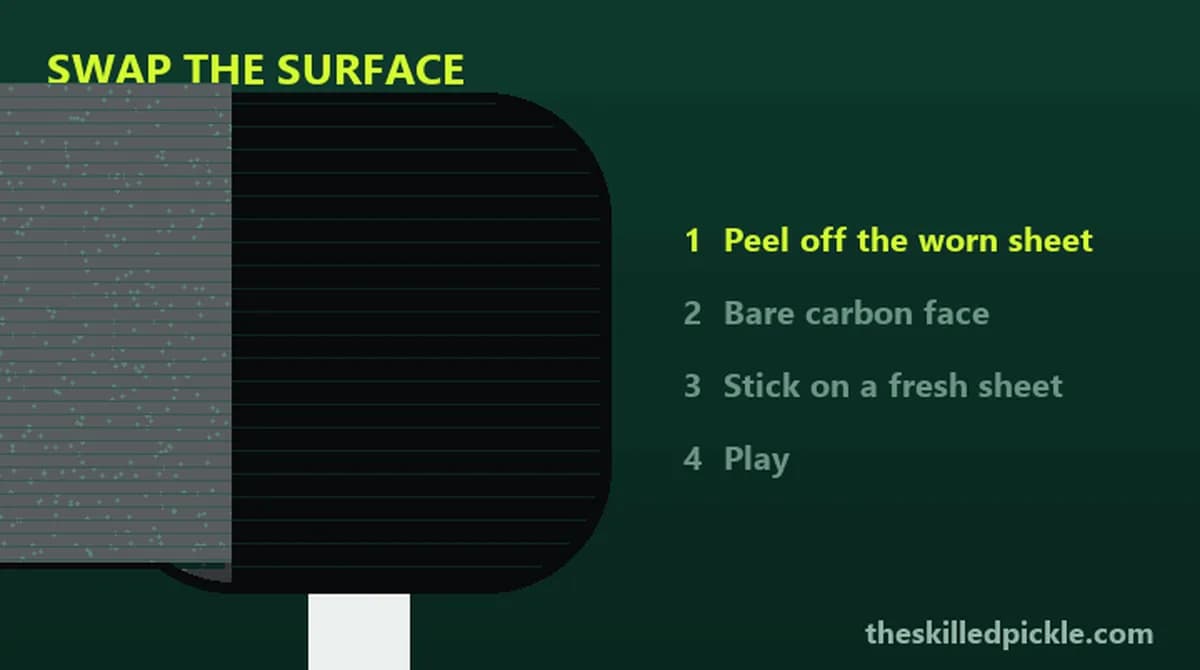
Reload sells a pickleball paddle where the gritty surface is a separate sheet you peel off and replace, instead of a coating that wears away with the paddle. The idea is simple: keep the paddle and refresh the spin. The channel Building Pickleball put the question in a short titled "Why is this banned?", and the topic is back in the news now that Gearbox is preparing its own replaceable sheets. This guide explains how the Reload system works, what it costs, what the company's wear test claims, and what we could and could not verify.
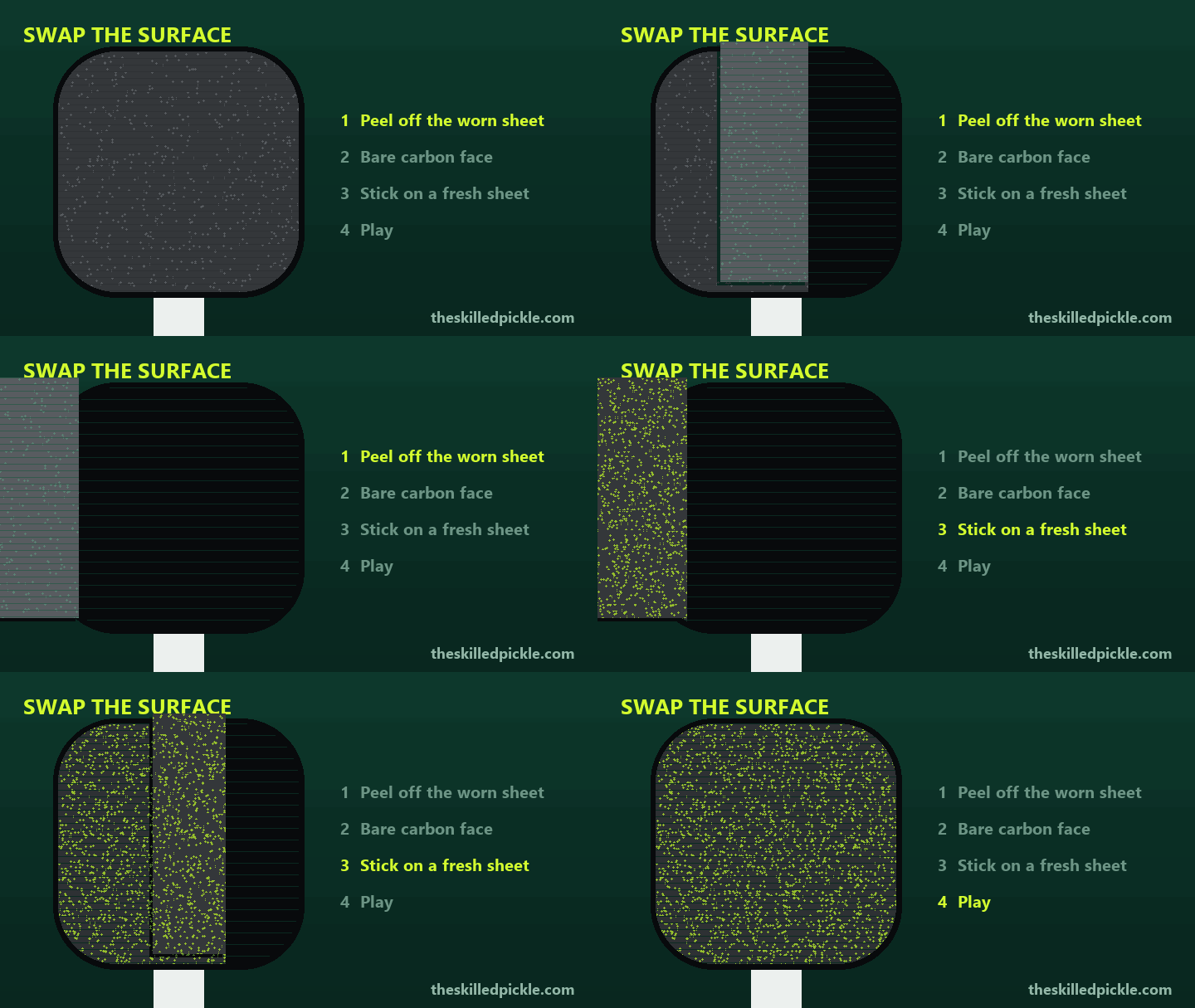
How the swappable texture works
According to Reload's own site, the RLD-1 is a paddle base with a replaceable surface. The sheet is unidirectional T700 carbon fiber, attached with a 3M adhesive, and each sheet has a recycled polyester pull tab. The company describes the swap as five steps: peel off the old grit, open the new pack, peel off the backing, attach the new sheet, and play. Reload says a swap takes about ten seconds, which we could not verify. The base is a thermoformed paddle with a polypropylene core, a T800 carbon fiber face and an overmolded butt cap.
Reload RLD-1 at a glance
| Detail | What Reload lists |
|---|---|
| Shape | Hybrid |
| Thickness | 16 mm (control) and 14 mm (power) |
| Surface | Replaceable unidirectional T700 carbon fiber sheet, 3M adhesive, pull tab |
| Paddle price | $200 for the RLD-1 system, which includes an extra 2-pack of sheets |
| Replacement sheets | Sold in 2-packs and 6-packs. Reload markets the idea as roughly $40 to refresh the grit, but we could not confirm a per-pack price |
| Approval claim | Reload says USA Pickleball approved. We could not confirm this on the USAP list |
We left out weight and swing weight because we could only see them in a summary of the page, not the page text. Check Reload's listing for the current numbers before you buy.
The wear claim, and who ran the test
Reload's pitch rests on a test it published in July 2024 on its own blog. The test used a Joola Hyperion CFS 16, not a Reload, and a ball machine firing topspin drives, counted as 540 shots to a day of play. Reload says it measured the surface with contact and optical profilers. Its headline claim is that a raw carbon paddle loses about 25 percent of its surface roughness in 7 to 10 days of play and as much as half after 30 days. The company reported figures between 46 and 49 percent loss at 30 days across its instruments.
Treat that as a company test on one paddle, run by a company that sells the fix. It is useful evidence that grit wears, but it does not tell you how fast your paddle wears. Reload's homepage frames the loss as up to 50 percent in 50 hours of play, which is a different unit from the blog's 30 days at 540 shots a day, so be careful comparing the two statements.
Is it legal?
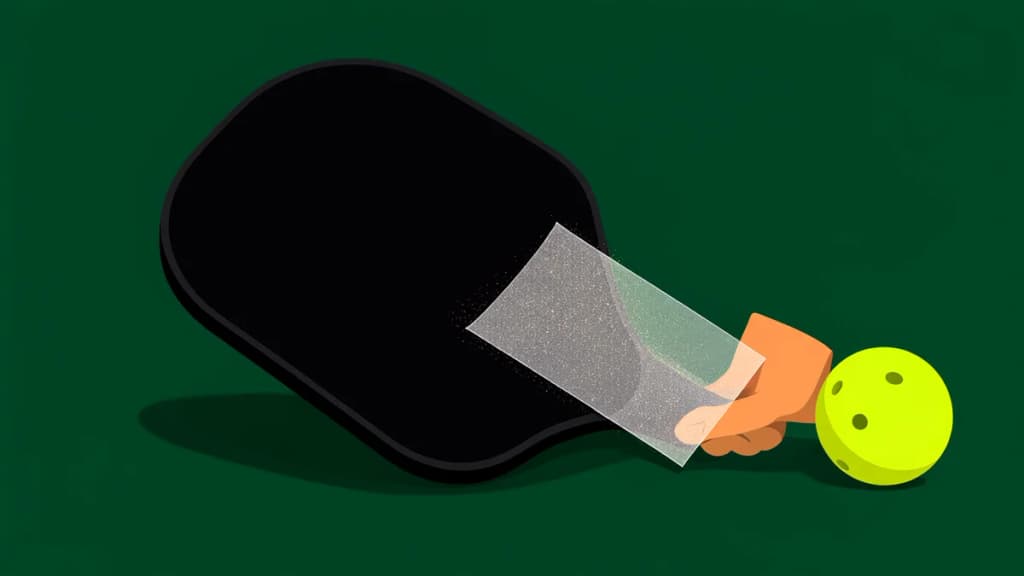
Reload's site says the RLD-1 is USAP approved. We checked the first page of USA Pickleball's approved paddle list and could not find it, and the list is large, so this is unconfirmed rather than wrong. Before you play a sanctioned event, search the current list yourself. USA Pickleball has also been active on surfaces in recent days: on November 9 it posted a statement classing several OWL Sport models as "degrade to benefit" and not approved for sanctioned play from February 1, 2028, and it says its spin rate test began on October 1, 2026. We found no ruling about replaceable sheets as a category. For another company entering this space, see our write-up of Gearbox RePly.
What users and reviewers say
Pickleball Effect published a review titled "Reload Paddle and Replaceable Raw Carbon Sheets Review," which is embedded below. We could not read its contents for this article, so we are not summarizing it. On Reload's own site the paddle shows an average of 4.9 out of 5 from 80 reviews. Those are the seller's reviews, not independent ones, but they point to a few themes: some owners find it a little head heavy, one praised its spin with a fresh sheet, and one noted that some sheets felt grittier than others, which the company said it was working on.
Who should consider it
- You play often and chase spin: if you replace paddles because the surface wears flat, a $200 base with replaceable sheets is the case Reload is making. Our guide on how often to replace a paddle covers the usual timeline.
- You want to stay on one paddle: a fresh sheet keeps the same core and feel, which matters if you are hunting for consistency.
- You play sanctioned events: confirm approval on the USAP list first.
- You are weighing the unknowns: long-term edge peeling and how sheets feel after several swaps are not covered by anything we could verify yet.
For how spin compares across popular paddles, see our spin comparison, and to compare other cores and shapes use the paddle finder.
Sources
- Reload: RLD-1 paddle system (product page and customer reviews)
- Reload: How fast do carbon fiber paddles wear out? (July 2024)
- Building Pickleball: Why is this banned? (YouTube Short)
- Pickleball Effect: Reload paddle and replaceable raw carbon sheets review
- USA Pickleball: statement regarding OWL Sport (November 9, 2026)
- USA Pickleball: approved paddle list