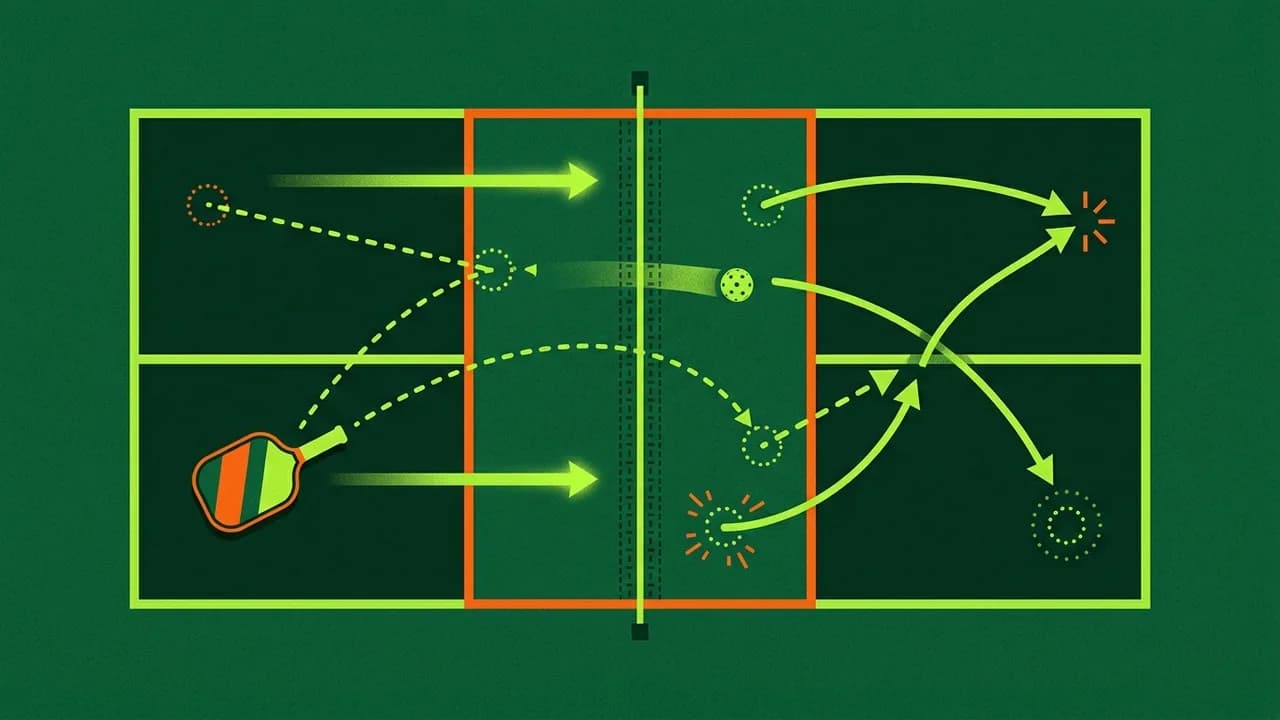
When to Speed Up a Dink: The Maths of Attack vs Reset

Every dink rally reaches a moment where the ball sits up a little and you have to decide: speed it up or keep dinking. Most players decide by feel, and feel is biased. People who just hit a winner want to attack everything, and people who just missed one never attack again. A short piece of arithmetic gives a better rule, and it fits on a napkin.
The model
We need three assumptions, and we state them so you can change them.
- Neutral dinking is worth a fixed value. If both teams keep dinking, you win the rally some share of the time. Call that share v. Against an equal opponent, v is 50%. If you are the better dinker, it is higher. If they are, it is lower.
- A speed-up ends one of three ways. You win the rally right away with probability w (a winner or a forced error). You lose it right away with probability l (you hit it into the net or out, or they counter and win). Otherwise, with probability 1 − w − l, they block or reset it and the rally goes back to neutral.
- A blocked speed-up returns to neutral, worth v again. This is a simplification, because the attacker often has a small edge after a speed-up that gets blocked, but it keeps the numbers honest.
The expected chance of winning the rally after a speed-up is then w + v × (1 − w − l).
When v is 50%
Against an evenly matched opponent, the formula simplifies to 50% + (w − l) / 2. The speed-up beats the dink whenever your immediate winners are more common than your immediate losses. Here is what that looks like:
| Wins outright (w) | Loses outright (l) | Rally goes on | Your chance to win the rally |
|---|---|---|---|
| 30% | 20% | 50% | 55% |
| 25% | 25% | 50% | 50% |
| 20% | 30% | 50% | 45% |
| 15% | 35% | 50% | 40% |
A speed-up that wins 30% and loses 20% looks scary because it loses one time in five. It still beats a neutral dink by five points. A speed-up that wins 15% and loses 35% feels aggressive and is worth ten points less than doing nothing.
When you are the better or worse dinker
Rearranging the formula gives a clean rule: attack when w ÷ l is bigger than v ÷ (1 − v). That is the win-to-loss ratio your speed-up needs to clear:
| Your chance in a neutral dink rally (v) | Speed-up needs a win-to-loss ratio above | Example that just breaks even |
|---|---|---|
| 40% | 0.67 | 20% wins, 30% losses |
| 50% | 1.00 | 25% wins, 25% losses |
| 60% | 1.50 | 30% wins, 20% losses |
| 70% | 2.33 | 35% wins, 15% losses |
The pattern is intuitive once you see it. If you out-dink your opponents, the bar for attacking rises, because you already have a good rally to protect. If they out-dink you, you can afford to gamble, because the neutral rally is a bad deal anyway. A weaker dinker who attacks a few more balls is not being reckless. They are doing the maths correctly.
What moves w and l in real rallies
You will never know your exact numbers mid-rally, but you can read the factors that shift them:
- Ball height. A ball above the net tape gives you a downward angle, so w goes up and l goes down. A ball below the tape means you have to hit up, and l climbs fast. Below the tape, the dink or a drop is usually the better choice.
- Where their paddles are. If both opponents have their paddles low and in front, the ball gets blocked back and your w is small. If one is leaning to a side or has dropped the paddle, w rises.
- Target. A speed-up at the hip or the middle line leaves the other team unsure who takes it. One at the feet of a player who is standing tall is hard to block. This is the same idea behind poaching, where the middle belongs to whoever is ready.
- Your position. If you are stretched or off balance, l rises, so reset instead. Our cross-court dinking guide covers how to keep the rally steady until the right ball comes.
- Your last attack. If a speed-up just got blocked or countered, the opponent is more ready for the next one. Wait for a clearly better ball.
How to use this in your games
- Count for a few games. After each speed-up, tick one of three boxes: won, lost or continued. Do this for several games and you will start to see whether you sit above or below the line.
- Set your own threshold. Use the table. If you win most of your dink rallies, only attack balls that are well above the tape. If you lose most of them, attack more, but attack the right ball.
- Practice the follow-up. The "rally goes on" branch is where speed-ups quietly gain or lose value. Players who put the ball at a body part and then get ready for a block keep more of that share. Our glossary explains terms like block and reset if you are new to them.
The same logic shows up at the pro level. In our review of the MLP championship match, the commentators kept returning to taking the ball out of the air instead of letting it bounce, which is the same timing idea in different words.
The limits of the model
The numbers above are illustrations, not measurements. Real rallies are not independent, and the value of a blocked speed-up is not always the same as a fresh dink rally. Fatigue, wind and nerves change w and l. The point is the structure: a speed-up is a trade between your immediate winners and your immediate losses, measured against how good your neutral game is. If you remember one thing, make it this: attack when your winners outnumber your mistakes by more than your dinking edge, and only then.