Stacking in Pickleball Doubles: When It Helps and How to Do It
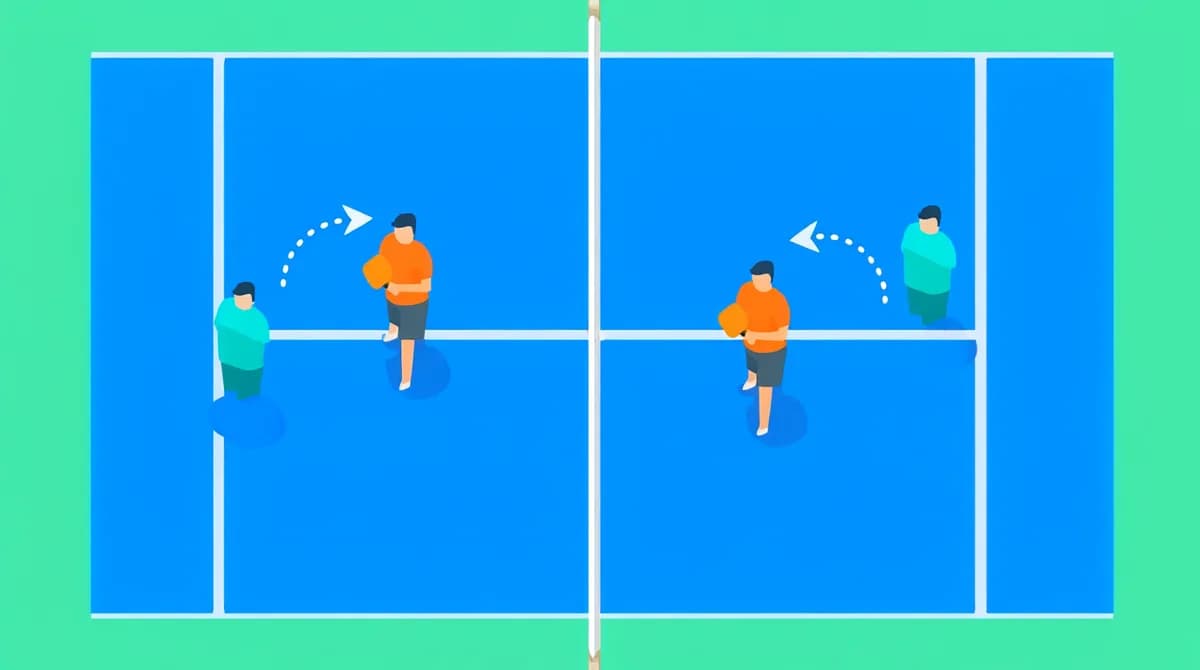
Stacking sounds like advanced tactics, but the idea is simple: you and your partner line up on the same side of the court before the serve, then slide to your preferred sides once the ball is in play. It works because of how doubles positioning is scored. This guide shows how the rotation runs, when it is worth the effort, and the mistakes that cost points.
Why stacking is allowed
In doubles, the serving score decides which player serves from which side. The server must be in the correct service box, and the receiver must be in the correct box to receive. After that, the rules do not tell the partners where to stand when the serve is struck. Stacking uses that gap. Once the ball is served and returned, both players are free to move, so they cross over and take their preferred sides.
Without stacking, partners swap sides every time the serving team scores. That means a player's forehand is sometimes in the middle and sometimes on the sideline, depending on the score. Stacking removes that randomness. See our rules of pickleball guide for the full serving order, and the kitchen rules for where you can and cannot stand when volleying.
A worked example
Say Alex is right-handed and Sam is left-handed. Standing with Alex on the left side and Sam on the right puts both forehands in the middle, where most of the contested balls go. Here is how that looks across a few points when your team is serving.
| Score (your team first) | Server | Server stands on | Partner starts | After the serve |
|---|---|---|---|---|
| 0-0-2 | Alex (right-hand side serve, even score) | Right | Left, next to the server | Alex steps across to the left, Sam moves to the right |
| 1-0-2 | Alex (odd score, left side) | Left | Right | Players are already where they want to be |
| 2-0-2 | Alex (even score, right side) | Right | Left | Alex steps across again |
The pattern is that the server has to be on the side the score demands. That means the server is sometimes on the wrong side for the rally and has to cross. The partner who is not serving can wait on the correct side from the start. Stacking is mostly about getting the receiving side and the serving side into the shape you want before the next point.
Stacking when you receive
On return, the receiver must stand in the correct box. The partner can stand anywhere on that side. If your forehand player is supposed to be on the left but the score puts the receive on the right, your partner receives and you start next to them, then both of you shift after the return. Agree before the game who takes which side so that nobody hesitates.
When stacking is worth it
- Different strengths: one partner has a clearly stronger forehand, backhand or reach, and you want that shot covering the middle.
- Left-handed and right-handed pairs: forehands in the middle cover the highest-traffic area of the court.
- One partner is the better receiver or net player: stacking lets that player stay on the side where they are strongest on every point.
- One partner struggles on one side: if a player hates their backhand-side dinks, stacking can hide it.
If both partners are about equal, stacking adds complexity without much gain. Most recreational pairs lose more points to confusion than they win from better positioning.
Common mistakes
- Serving or receiving from the wrong box. This is a fault, so check the score before every serve and know who is serving.
- Crossing too early. Move after the serve is struck, not while the server is tossing or swinging.
- Colliding in the middle. Call your side out loud on every point. Our poaching guide covers who takes middle balls.
- Letting the server arrive late. The server has the longest distance to the kitchen line and can be caught out of position on a deep return. A reliable return against your team makes this worse, so serve deep.
- Changing the plan mid-game with no signal. Pick a simple hand sign or phrase for each point.
How to start
- Play three or four games without stacking so you both know the serving order cold.
- Decide which side each player prefers, and why, in one sentence each.
- Stack only when you serve first, then add receiving stacks once that feels easy.
- Use a clear call, such as "me left" or "you left", before each serve.
- After a game, compare points won on each side. If there is no difference, drop it.
Stacking also does not replace good shot choice. Whichever side you end up on, the basics from serve or return still apply. For the vocabulary, the pickleball glossary defines the terms used here.