Pickleball Court Dimensions: Size, Kitchen, Net Height and Diagram
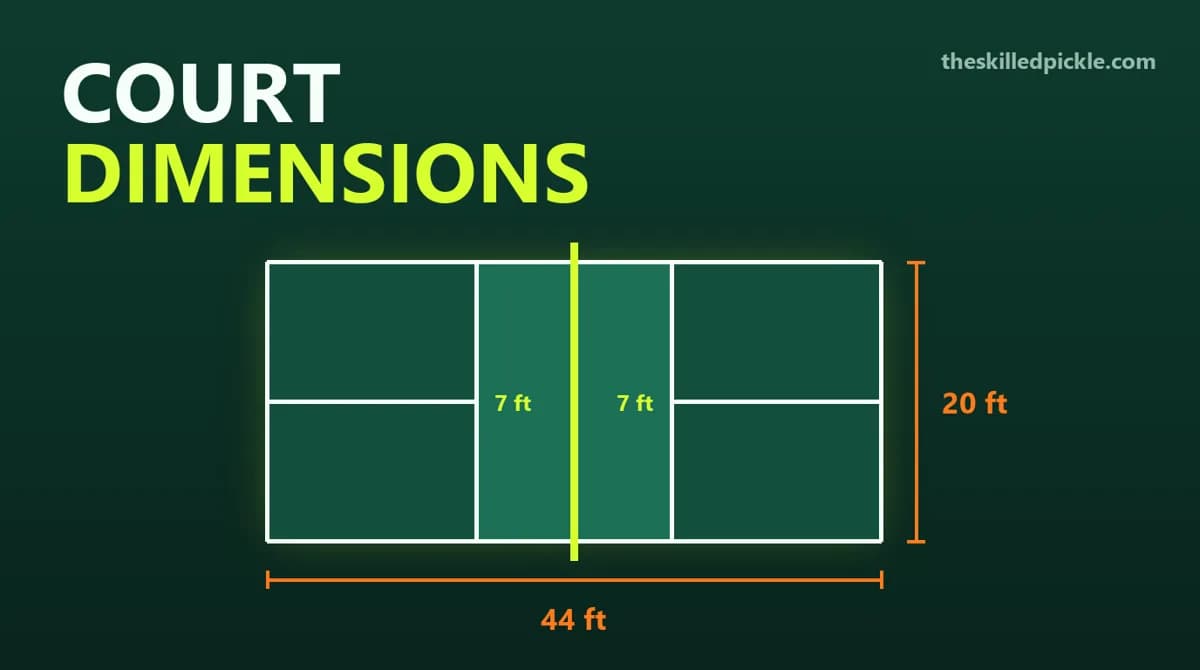
A pickleball court is 20 feet wide and 44 feet long, and that size is the same for singles and doubles. The net sits at the exact middle, 22 feet from each baseline, and a 7 foot no-volley zone, the kitchen, runs on both sides of it. Those few numbers set up almost every rule and strategy in the game. This guide gives every official measurement, a scale diagram you can reuse, and the space you need around the court. If you are comparing it with another racket sport, our pickleball vs tennis comparison puts the sizes side by side.
Pickleball court dimensions at a glance
| Measurement | Imperial | Metric |
|---|---|---|
| Court length (baseline to baseline) | 44 ft | 13.41 m |
| Court width (sideline to sideline) | 20 ft | 6.10 m |
| Non-volley zone (kitchen), each side of net | 7 ft deep | 2.13 m |
| Service court (kitchen line to baseline) | 15 ft deep by 10 ft wide | 4.57 by 3.05 m |
| Line width | 2 in | 5.1 cm |
| Net height at the sidelines | 36 in | 91.4 cm |
| Net height at the center | 34 in | 86.4 cm |
| Space between net posts | 22 ft | 6.71 m |
The court, kitchen, line width, net height and post spacing come from Section 2 of the 2025 USA Pickleball rules as published by PlayPickleball.com. The service court size comes from Pickleball.com's setup guide; the rules text we read does not give those two numbers. Metric figures are converted from feet and inches.
The lines, zone by zone
- Baseline and sidelines. The outer rectangle is 44 by 20 feet.
- The kitchen. The non-volley zone is 7 feet from the net on each side and spans the full width of the court. Its lines belong to the zone, so you cannot volley with a foot on the kitchen line. Our guide to the rules of the kitchen covers the details, including when you may step in.
- The service courts. Behind each kitchen line, the area to the baseline is 15 feet deep. The centerline splits it into two boxes, each 10 feet wide by 15 feet deep on the Pickleball.com figures, and it separates the odd and even service courts. The full serving sequence is in our rules of pickleball guide.
- Line colour. The rules say all lines must be the same colour and clearly contrast with the surface. They do not name a colour, though lines are typically white.
Net height and posts
The net is 36 inches high at the posts and 34 inches at the center, each with a tolerance of a quarter inch. The center height is measured at the center strap if the net has one. The posts are set 22 feet apart, measured between their inside faces, and the rules cap post diameter at 3 inches. That makes the middle two inches lower than the sides, so a net that measures 36 inches at the center is too high.
How much space do you need?
| Setup | Area | Source note |
|---|---|---|
| Court itself | 20 by 44 ft (880 sq ft) | Rules, Section 2 |
| Minimum playing surface | 30 by 60 ft | Rules, Section 2 (5 ft margin each side, 8 ft behind each baseline) |
| Recommended for new courts and tournaments | 34 by 64 ft | A recommendation in the rules, though Pickleball.com calls it a requirement |
| Generous run-off | 40 by 64 ft (rules) or 40 by 68 ft (Pickleball.com) | The two sources give different largest sizes |
The sources disagree on a few of these, so check with the organizer or the owner of your facility before you build to a number. If you are planning a driveway or backyard court, see our guide to building a pickleball court at home.
Fitting courts onto a tennis court or in a gym
A tennis doubles court is 78 by 36 feet. Pickleball.com says it can host one, two or up to four pickleball courts depending on how much run-off you allow, and we walk through the layouts in how many pickleball courts fit in a tennis court and how to play pickleball on a tennis court. The sources we read give no figure for basketball courts, so we are not guessing one.
Why the size matters for play
At 880 square feet the court is a small fraction of a tennis court's doubles area of 2,808 square feet, which is why points involve more net play and less running. The kitchen then forces the soft game: you cannot volley from the zone, so players trade dinks and drops from just behind it.
Find a court near you
Once you know what a regulation court looks like, use our court finder to find one near you, with surface and lighting details where we have them.