Pickleball Doubles Strategy: The Complete Guide
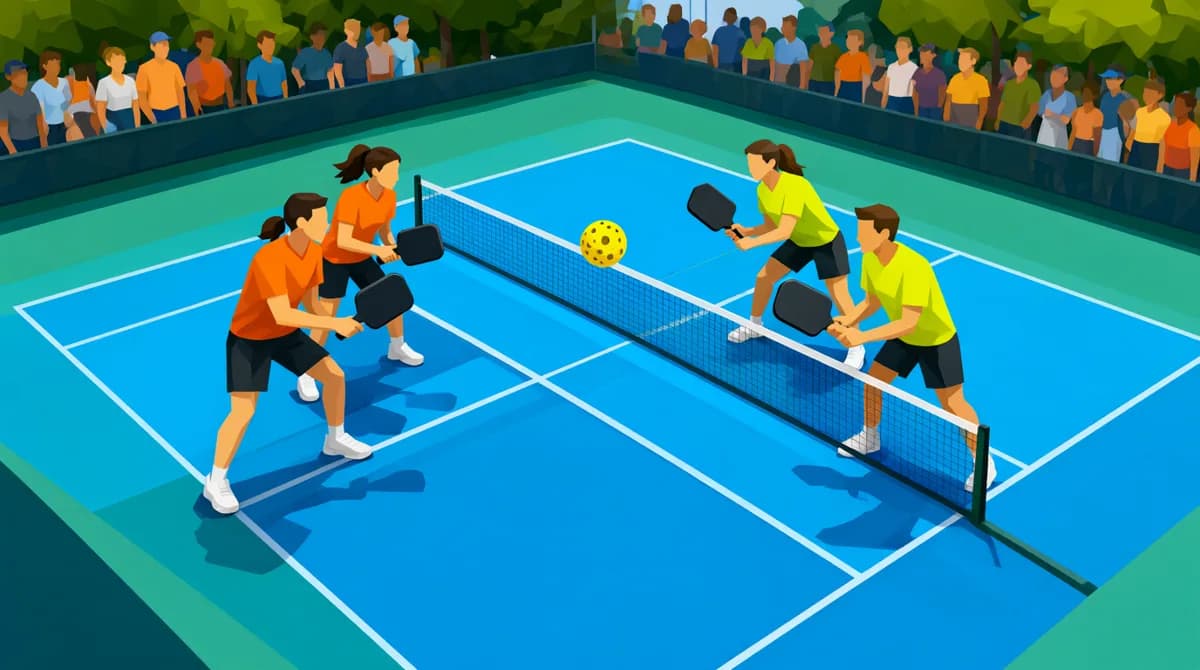
Good pickleball doubles strategy comes down to a few ideas that repeat on every point: get both players to the kitchen line, move as a pair, keep the ball where your opponents cannot attack it, and attack only when the odds favour you. This guide walks through a rally in order, from serve to speed-up, and links to our deeper guide on each shot.
The rules that shape doubles tactics
Three rules explain much of what strong teams do. All three are in the 2026 USA Pickleball Official Rulebook.
- Two bounces first (rule 10.A). The serve and the return must each bounce before being played. The serving team cannot rush the net behind its serve, so the returning team gets the first chance to take the kitchen line.
- No volleys from the kitchen (rule 11.A). Volleys must start outside the non-volley zone, and momentum that carries you into it is a fault. The line, not the net, is the spot to hold.
- Free movement during the rally (rule 5.B.4). Apart from serving and receiving, there is no restriction on where players stand on their side. Stacking and poaching rely on this.
For the rest, see our rules of pickleball guide.
One rally, shot by shot
| Shot | Who | Main goal | Common mistake |
|---|---|---|---|
| Serve | Server | In, and deep | Missing while going for too much |
| Return | Receiver | Deep, with time to reach the line | A short, rushed ball |
| Third shot | Serving team | Earn the way forward | Running in behind a high ball |
| Dink rally | All four | Stay unattackable, wait for height | Speeding up from below the net |
| Hands battle | All four | Block, reset or finish | Big swings at close range |
Serve: do not give the rally away
A service fault loses the rally before it starts. Aim for the back third of the service court with a motion you can repeat under pressure. Our guide to the pickleball serve covers technique, and the role of the server in doubles explains the first and second server order.
Return of serve: depth buys you the net
Your partner can already be waiting at the kitchen line. Send the return deep, with enough height to give yourself time, and follow it in. A deep ball also pins the third-shot hitter back. More on footwork and targets is in our return of serve guide.
Third shot: drop or drive
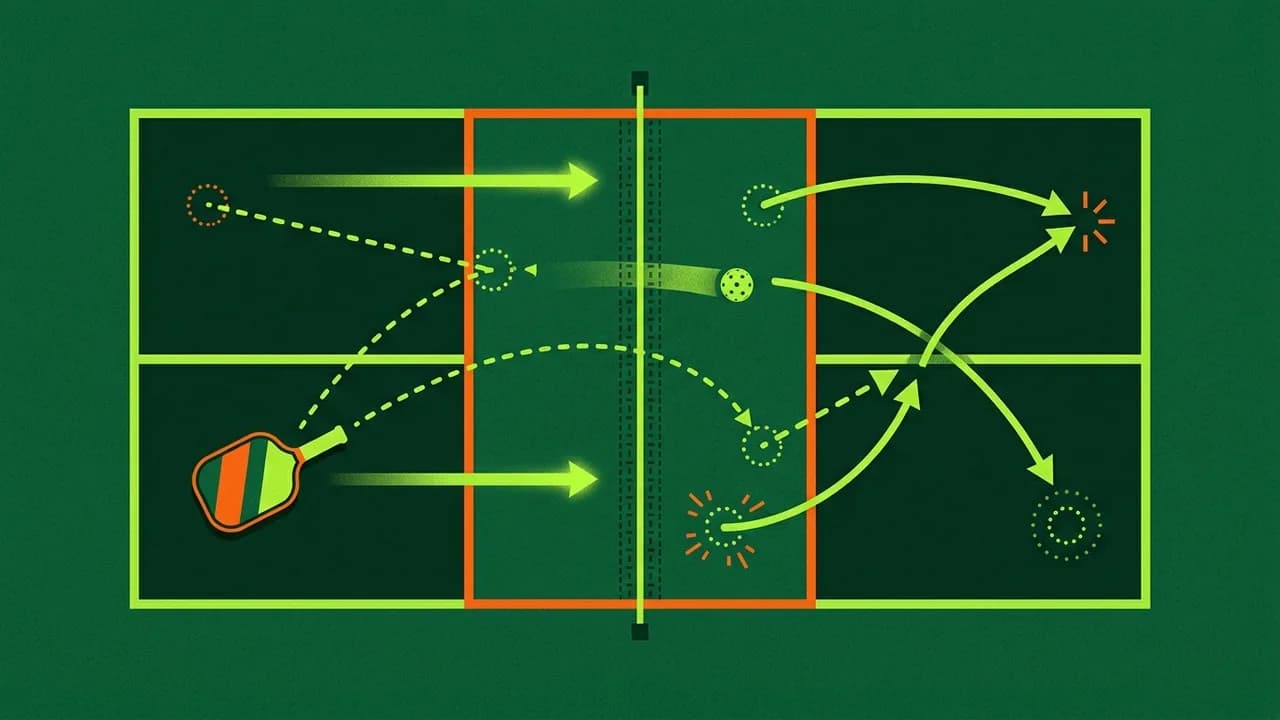
The third shot is how the serving team climbs out of its hole. A drop is a soft arc that lands in or near the kitchen, so the opponents have to hit up while you move forward. A drive is hit hard and low, usually to draw a weaker reply that you can drop or attack on the fifth shot. As a working rule, drop when the return is deep and you are stretched, and drive when the return sits up in front of you.
Learn the soft option first with our third shot drop and drop shot technique guides, then add the third shot drive. For a longer comparison, see third shot strategies.
Move as a pair
Imagine a short rope between you and your partner. When one of you is pulled toward a sideline, the other slides the same way to protect the middle. When one moves up, the other comes too if the ball allows it. Gaps open when one player is at the line and the other is stranded halfway. After a poor third shot, it is often better for both to hold back and reset than for one to charge.
Agree who takes the middle before the match. One common choice is the player whose forehand is in the middle; another is the player who is already moving toward the ball. Whichever you pick, call "mine" or "yours" early. Our post on doubles communication has more.
The dink rally: patience with a purpose
At the line, the aim is to give your opponents balls they must lift while you wait for one you can hit down. A crosscourt dink crosses near the lower middle of the net and has a longer path to land in. A dink to the middle can make two opponents hesitate. See cross-court dinking for patterns and how the dink works for the basics.
When to speed it up
Treat an attack as a bet. Estimate how often your speed-up wins the rally outright and how often it loses it outright, and call your chance of winning a neutral dink rally v. In our simple model, attacking pays when wins divided by losses is greater than v divided by (1 minus v). Against an even opponent, that means winning outright more often than you lose outright. If you win 60% of long dink rallies, the speed-up needs a ratio above 1.5 to 1. The working is in the maths of attack vs reset.
Poaching, lobs and other pressure
A poach is crossing to take a ball that was heading to your partner. Go when your opponent is stretched, commit fully, and have your partner cover the side you leave. Our poaching guide covers timing. The lob answers opponents who lean over the kitchen line. Use it as a surprise rather than a habit, because a short lob hands them an overhead. See lob strategy.
Stacking
Stacking lines partners up so that each can slide to a preferred side after the serve or return, often to keep both forehands in the middle with a right-hander and a left-hander. It helps when your strengths are clearly lopsided and hurts when it causes confusion about who serves. The step-by-step is in our stacking guide.
What the scoreboard maths says
In traditional side-out scoring you only score while serving, but that does not make returning less important. We simulated games to 11, win by 2, with independent rallies, 100,000 games per matchup.
| You win this share of your serving rallies | Opponent wins this share of theirs | Your chance to win the game |
|---|---|---|
| 60% | 60% | 50% |
| 65% | 60% | 62% |
| 60% | 55% | 62% |
Taking five more rallies per hundred off your opponent's serve was worth the same as winning five more per hundred on your own. Real rallies are not independent, so read this as the shape of the game, not a forecast. Details are in serve or return. Some tournaments may use rally scoring instead (rule 15.C.2, a provisional rule), which changes the arithmetic.
A five-point checklist for your next match
- Serve in, return deep.
- The returner gets to the line; the serving pair earn their way there.
- Shift together and agree who takes the middle.
- Hit low balls softly; attack the ones you can hit down.
- Between games, name one thing that is losing you rallies and change only that.
Sources
- USA Pickleball: 2026 Official Rulebook
- The rally and scoring figures are from our own models, linked above. The tactical advice is general coaching guidance, not a rule.